Revolutionizing Emergency Communication
In real world disaster scenarios, fragmented communication can severely hinder coordination of first responders. ANKOMMEN Project aims at combining technologies into a standardized, interoperable solution, to complement current protocols like TETRA.
Key Features
01
Ad-hoc deployable
02
Adaptable to various scenarios
03
Secure
04
Modular
05
Handheld-to-Handheld communication via 5G Sidelink
06
5G Satellite communication
07
Compatible with 5G campus networks
08
Mission-critical communication services for voice, video, and data
Pioneering Innovations
01
Integration of Mission Critical Services (MCX) into nomadic 5G systems.
02
Validation of Handheld-to-Handheld communication via relaying (e.g., drones) into MCX networks, based on ETSI/3GPP Release 18.
03
Testing 5G NTN under lab conditions for realistic emergency scenarios.
04
Developing roaming solutions between campus networks.
Use Cases
Use Case 1 – Roaming
Roaming use case explores the seamless transition of a user device between a nomadic network and a visited network as the user moves out of the primary network’s coverage area. When the device detects diminishing signal quality from the nomadic network, it automatically initiates a handover to the visited network without interrupting ongoing sessions. This ensures continuity for services such as voice calls, video streaming, or real-time applications, leveraging advanced mobility management protocols to minimize latency and prevent data loss during the transition.
In this scenario, we will demonstrate a local breakout type 5G roaming setup, where data traffic from the user in the visited network is routed directly through the visited network’s infrastructure, instead of being routed back to the nomadic (home) network. This approach reduces latency, improves data speeds, and ensures efficient resource utilization by leveraging 5G’s advanced capabilities. By harmonizing communication and registration between the nomadic and visited networks, the user experiences uninterrupted connectivity and enhanced performance in dynamic roaming environments, showcasing the power of local breakout in 5G roaming.
Use Case 2 – Sidelink Communication
Sidelink Communication focuses on investigating how 5G sidelink communication can support emergency services, such as fire brigades and police forces, in scenarios where public mobile network coverage is unavailable. This includes situations like natural disasters, large scale fires, power outages, or operations in remote areas. 5G sidelink, operating via the PC5 interface, enables direct, network independent communication between devices, offering secure, robust, and immediate connectivity for effective coordination and personnel safety. It complements existing communication systems by providing features like group communication, one-to-one communication, and messaging based services in out of coverage scenarios.
The research examines the suitability of 3GPP defined NR Sidelink mechanisms for emergency response operations, focusing on key factors such as range, reliability, latency, and scalability. It also explores the limitations and dependencies of using Sidelink without a gNB or 5G core network, assessing its practical feasibility in fully network independent situations. Additionally, the use case identifies operational scenarios that can be effectively supported by sidelink communication and highlights any functional gaps compared to established mission critical communication systems.
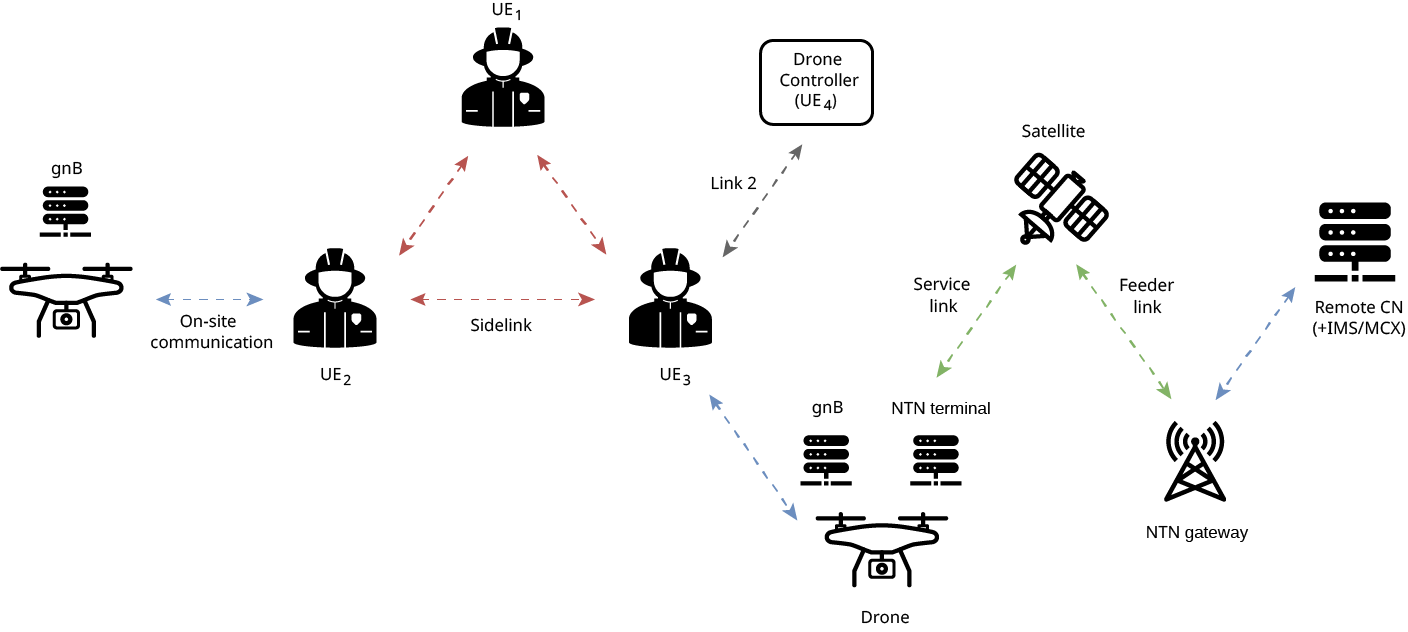
Use Case 2.1 illustrates a scenario where one user device (UE3) is connected to a nomadic network and acts as a relay node to provide connectivity for other unconnected devices (UE1 and UE2) via sidelink communication.
Use Case 2.2 presents a situation where all user devices are outside the coverage of a 5G network and communicate directly with one another using sidelink communication.
Use Case 3 – Non-Terrestrial Networks (NTN)
NTN use case explores how a nomadic 5G campus network deployed at an incident site can maintain connectivity with a remote 5G core (including IMS/MCX services) using a satellite based IP backhaul when terrestrial backhaul infrastructure is unavailable. The satellite link primarily handles control plane signaling (e.g., N2 signaling and management traffic) between the on site gNB and the secure core network, while user plane traffic for first responders remains local to minimize latency and optimize the limited satellite bandwidth. At the incident site, local 5G cells, mounted on vehicles or drones, provide MCX voice, video, and data services, ensuring efficient communication for first responders while enabling access to centralized services and monitoring via the satellite backhaul.
This use case addresses key research questions, such as designing an architecture that separates control and user plane traffic, adapting to satellite link characteristics (e.g., high latency, jitter, limited capacity), and determining the minimum KPIs (e.g., availability, latency, throughput) needed for public safety. It also investigates techniques like traffic prioritization, compression, and caching to optimize backhaul efficiency. Through prototyping and field trials, the project aims to demonstrate the feasibility of integrating satellite backhaul into a nomadic 5G emergency communication system to enhance its resilience and reliability in disaster scenarios.
Partners
Expertise in sidelink communication, 3D network architectures, and autonomous drone technology.
Leading research in 5G/6G applications and campus networks.
Comprehensive provider of critical communication solutions with a focus on 5G and MCX technologies.
Expertise in intelligent automation, real-time communication, and private 5G networks.